




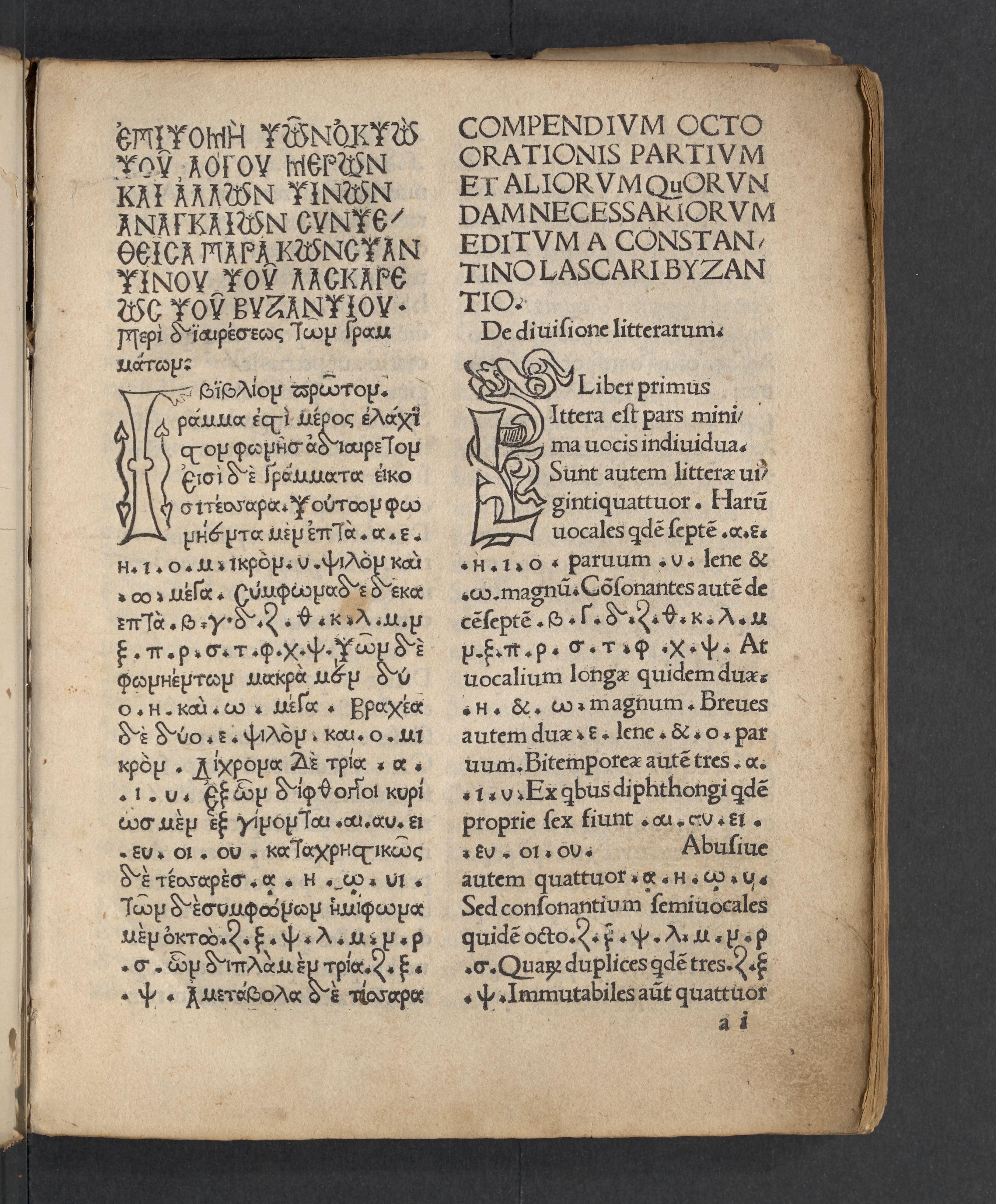
In the Early Modern period, Latin was not only the language of culture but also an active and prestigious medium of intellectual exchange. It stood at the crossroads of Europe’s linguistic landscape, interacting continuously with vernacular and other ancient languages, in particular Greek. Through Latin, texts could travel beyond regional and national boundaries, entering new cultural and educational contexts. Translation into Latin thus became one of the most powerful vehicles for the transnational circulation of knowledge. The spread of printing from the fifteenth century onward further intensified this process, multiplying copies, audiences, and points of contact across the continent.
Within this vibrant print culture, bilingual and multilingual editions represent a particularly revealing phenomenon. These books placed two or more languages in direct relation on the page, presenting an original text alongside its Latin translation, or pairing a Latin work with a vernacular rendering. The coexistence of languages was not a neutral choice: it required specific editorial strategies, typographical solutions, and clearly defined assumptions about readership. Parallel columns, facing-page layouts, and interlinear translations were material responses to the needs of a polyglot society. Multilingual books shaped the reader’s experience, guided interpretation of the texts, and made visible the intended function of the volume, whether pedagogical, scholarly, political, or devotional.
This project aims to create and investigate the first digital corpus dedicated to bilingual and multilingual editions printed in the Renaissance period that include Latin translations and their corresponding source texts. The goal is to understand not only how translations were produced, but also how they were embedded in the material, intellectual, and economic realities of the early modern book world.
The analysis approaches these editions as complex cultural artifacts. It considers their paratexts – prefaces, dedications, commentaries, and epilogues – as key sites in which translators and editors articulated their intentions, justified their choices, and addressed specific audiences. It examines the roles of printers and publishers, whose technical expertise and commercial strategies influenced the physical form, layout, and circulation of multilingual books. It also investigates patterns of readership, exploring how these volumes functioned in schools, universities, confessional settings, and private libraries, and how they mediated between different linguistic communities.
Equally central is the study of materiality. The layout of the page, the use of typefaces for different languages, the organization of marginalia and commentary, and the integration of translation with the original text all reflect broader developments in typographical technique and book design. In this sense, multilingual editions offer a privileged vantage point from which to observe the interaction between linguistic practice and material innovation within the broader history of print culture.
By situating Neo-Latin translations within their historical, intellectual, and commercial contexts, the project seeks to show how these works participated in the construction of a shared European culture. Multilingual printed books will be studied as instruments of mediation, negotiation, and cultural transfer. Studied collectively through a digital corpus, they will reveal the extent to which translation, print technology, and readership converged to shape the intellectual landscape of early modern Europe and to redefine the relationship between language, knowledge, and readership.
Team Members


Sub Project 5’s Contributions and Activities
No posts were found.