





Principal Investigator of Sub-Project 3
Contact
University of Innsbruck
Department for Classical Philology and Neo-Latin Studies
room 06M010 (6th floor)
Innrain 52a (Ágnes-Heller-Haus)
A-6020 Innsbruck, Austria
phone: +43 512 507-40702
email: martin.korenjak@uibk.ac.at
Biography
Education
1994 Master in Classics (Greek and Latin); Master in Linguistics (Univ. of Innsbruck, Austria)
1996 PhD in Classics (Univ. of Heidelberg, Germany)
1999 Habilitation (venia docendi for Greek and Latin, Univ. of Innsbruck, Austria)
Positions
1997–99 Assistant Professor of Latin and Greek (Univ. of Innsbruck)
1999–2003 Associate Professor (ibid.)
2003–09 Full Professor of Classics, esp. Latin (Univ. of Bern, Switzerland)
2009–today Full Professor of Classics and Neo-Latin (Univ. of Innsbruck)
2011–17 Key Researcher at the Ludwig Boltzmann Institute for Neo-Latin Studies (Innsbruck)
2017–23 PI of the Advanced Grant ERC Project NOSCEMUS: Nova Scientia: Early Modern Science and Latin
Academic achievements and recognitions
1999: co-founder, with Karlheinz Töchterle, of the bi-/triennial conference series PONTES on the reception of classical antiquity; co-organizer of five of the conference’s ten instalments so far
2002 and 2008: elected to four chairs of Classics / Latin / Neo-Latin (Bern, Frankfurt a.M.; Innsbruck, Freiburg i.B.)
2011(–24): co-applicant (with F. Schaffenrath, L. Subaric, S. Tilg, K. Töchterle) for the Ludwig Boltzmann Institute for Neo-Latin Studies
2017(–23): Advanced Grant of the European Research Council; PI of the project NOSCEMUS: Nova Scientia – Early Modern Science and Latin
2018: Tiroler Landespreis für Wissenschaft
2019: corresponding member of the Austrian Academy of Sciences
2023: nominated for the Austrian Wittgenstein Award
2024: nominated for the Balzan Prize (history of science)
Research Interests
I started my career as a classical scholar, writing my dissertation on Lucan’s Bellum Civile and my habilitation thesis on Greek rhetoric and eloquence. Both Roman poetry and classical rhetoric have remained among my fields of interest, along with literary theory and criticism and the reception of classical antiquity in later periods. From the early 2000s, Neo-Latin literature became my main field of activity. Within it, I have focused on regional Latinity, the history of mentalities and ideas as reflected in early modern Latin texts, Latin as the language of natural science, and now on the oral use of Latin in the early modern world.
Publications
I. Books
Die Ericthoszene in Lukans Pharsalia: Einleitung, Text, Übersetzung, Kommentar, Frankfurt a.M.: Peter Lang, 1996
Publikum und Redner. Ihre Interaktion in der sophistischen Rhetorik der Kaiserzeit, Munich: C.H. Beck, 2000
Johannes Leucht, Epithalamium Heroicum. Ein lateinisches Hochzeitsgedicht für Erzherzog Ferdindand II. und Anna Caterina Gonzaga, Innsbruck: Universitätsverlag Wagner, 2002
Ps.-Skymnos, Welt-Rundreise. Einleitung, Text, Übersetzung, Kommentar, Hildesheim/Zürich/New York: Georg Olms Verlag, 2003
Geschichte der neulateinischen Literatur. Vom Humanismus bis zur Gegenwart, Munich: C.H. Beck, 2016
Neulatein. Eine Textsammlung. Lateinisch/Deutsch, Stuttgart: Reclam, 2019
Latin Scientific Literature, 1450–1850, Oxford: OUP, 2023
Latein. Porträt einer Weltsprache, Munich: C.H. Beck, 2025
II. Edited volumes
a) Book series
Comparanda. Literaturwissenschaftliche Studien zu Antike und Moderne, Innsbruck/Vienna/Munich: StudienVerlag, 2000–2020 (with S. Donat, W. Kofler, K. Töchterle, B. Burtscher-Bechter, M. Sexl)
Tirolensia Latina, Freiburg i.B./Berlin/Vienna: Rombach, 1997ff. (2012ff.)
Zetemata, Munich: C.H. Beck,1951ff. (2015ff., with J. Grethlein, U. Wiemer)
Studienkommentare zu lateinischen und griechischen Texten, Göttingen et al.: Vandenhoeck & Ruprecht, 2022ff. (with D. Berrens, K. Wesselmann, B. Zimmermann)
b) Single volumes
Pontes I. Akten des ersten Innsbrucker Kongresses zur Rezeption der klassischen Antike vom 30.9.–2. 10. 1999, Innsbruck/Vienna/Munich: Studienverlag, 2001 (Comparanda 2; with K. Töchterle)
Pontes IV. Akten des vierten Kongresses zur Rezeption der klassischen Antike vom 30.9.–2.10.2005: Die Antike in der modernen Alltagskultur, Innsbruck/Vienna/Munich: Studien Verlag, 2007 (Comparanda 9; with St. Tilg)
Pontes VI: Der Altsprachliche Unterricht in der Frühen Neuzeit, Innsbruck/Vienna/Munich: Studien Verlag, 2010 (Comparanda 14; with Florian Schaffenrath)
Gipfel der Zeit. Berge in Texten aus fünf Jahrtausenden. Karlheinz Töchterle zum 60. Geburtstag, Freiburg i.B./Berlin/Vienna: Rombach, 2010 (Paradeigmata 12; with W. Kofler, F. Schaffenrath)
Tyrolis Latina. Geschichte der lateinischen Literatur in Tirol (2 Bde.), Vienna/Köln/Weimar: Böhlau, 2012 (with F. Schaffenrath, L. Subaric, K. Töchterle); darin 20 Beiträge im Umfang von ca. 450 S., z.T. in Koautorschaft
Alltag – Albtraum – Abenteuer. Gebirgsüberschreitung und Gipfelsturm in der Geschichte, Vienna/Köln/Weimar: Böhlau, 2015 (with M. Kasper, R. Rollinger, A. Rudigier)
Pontes VIII: Supplemente antiker Literatur, Freiburg i.B.: Rombach, 2016 (Paradeigmata 29; with Simon Zuenelli)
Entdeckungen der Landschaft. Raum und Kultur in Geschichte und Gegenwart, Vienna/Köln/Weimar: Böhlau, 2017 (with M. Kasper, R. Rollinger, A. Rudigier)
Pontes X: Die antike Literatur und die Wissenschaftliche Revolution, Baden-Baden: Nomos, 2023 (Paradeigmata 73; with Irina Tautschnig)
III. Articles
“Parthenope und Parthenias: Zur Sphragis der Georgika”, Mnemosyne 48 (1995) 201–02
“Pallas, Athene und der Schluß der Aeneis”, Mnemosyne 50 (1997) 337–42
“Le Noctes Atticae di Gellio: I misteri della ΠΑΙΔΕΙΑ”, Studi Italiani di Filologia Classica 16 (1998) 80–82
“Homerische Intertextualität ohne Formeln? Zwei phorminxspielende Helden in Ilias und Odyssee”, Materiali e Discussioni 40 (1998) 133–43
“Addikritisu: ein namentlich genannter Grieche aus der Zeit Asarhaddons. Überlegungen zu ABL 140”, Altorientalische Forschungen 28 (2001) 325–37 (with R. Rollinger)
“Die beste Tragödie? Die Consolatio des Boethius und das dramatische Verständnis des platonischen Dialogs”, Poetica 2001, 23–50
“Homer und die sophistische Rhetorik der Kaiserzeit. Ein komparatistischer Versuch”, Museum Hekveticum 60 (2003) 129–45
“Tityri sub persona. Der antike Biographismus und die bukolische Tradition”, Antike & Abendland 49 (2003) 58–79
“Vom primus amor zur fama perennis: Amores 1 in den Metamorphosen”, Würzburger Jahrbuch für die Altertumswissenschaft 28b (2004) 85–90
“Italiam contra Tiberinaque longe / ostia. Virgil’s Carthago and Eratosthenian Geography”, Classical Quarterly 54 (2004) 646–49
“Abschiedsbriefe. Horaz’ und Ovids epistolographisches Spätwerk”, Mnemosyne 58 (2005) 46–61, 218–34
“‘Unbelievable confusion’. Weshalb sind die Hieroi Logoi des Aelius Aristides so wirr?”, Hermes 133 (2005) 215–34
“Ein neues Fragment des Hekataios von Abdera. Eine Fußnote zu FGrHist 1 und 264”, Philologus 149 (2005) 347–51
“In piscibus obsonatores et rhetores: Petr. 39.13”, Cambridge Classical Journal 52 (2006) 134–38
“Von den Metamorphosen zum Augustusbrief: Ovids ‘horazische Periode’”, in: M. Janka et al. (eds), Ovid. Werk – Kultur – Wirkung, Darmstadt 2007, 239–56
“Aelius Aristides”, in: B. Noack et al. (eds), Epitaphien. Tod, Totenrede, Rhetorik. Auswahl, Übersetzung und Kommentar, Rahden/Westfahlen 2007, 291–341
“Iam exclamativum”, Classical Quarterly 58 (2008) 384–87
“Antikenfilme ohne klassische Antike? Das Beispiel China”, in: T. Lochman/T. Späth/A. Stähli (eds), Antike im Kino. Auf dem Weg zu einer Kulturgeschichte des Antikenfilms, Basel 2008, 228–37
“Eine alte Gattung neu erfunden. Die Apologi Centum des Leon Battista Alberti”, Philologus 152 (2008) 320–42
“Applausus ad Principem Eugenium. Ein neulateinisches Ereignislied”, Neulateinisches Jahrbuch 10 (2008) 177–94
“Kritische und interpretatorische Bemerkungen zu den Apologi Centum des Leon Battista Alberti”, Humanistica Lovaniensia 57 (2008) 61–90
“ΛΕΥΚΗ: Was bedeutet das erste ‘Akrostichon’?”, Rheinisches Museum 152 (2009) 392–96
“Ps.-Dionysius on Epideictic Rhetoric: One Complete Treatise”, Harvard Studies in Classical Philology 105 (2010) 239–54
“Tibull: Werkstruktur und Gattungsverständnis”, Gymnasium 117 (2010) 575–90
“Conversing With Posterity. Hermogenes, Aristides, and Sophistic φιλοτιμία”, in: G. Roskam et al. (eds), The Lash of Ambition. Plutarch, Imperial Greek Literature and the Dynamics of Philotimia, Löwen et al. 2012, 253–66
“Short Mythological Epic in Neo-Latin Literature”, in: M. Baumbach and S. Bär (eds), Brill’s Companion to Greek and Latin Epyllion and Its Reception, Leiden 2012, 519–36
“Ps.-Skymnos (Nr. 2048)”, in: H.-J. Gehrke (ed.), Die Fragmente der griechischen Historiker V: Geographen, zugänglich über Brill Online (vollständig umgearbeitete Version der Ausgabe von 2003)
“What Does it Mean: Mens Sana in Corpore Sano? A Latin Adage and its Curious Career”, in: W. Petermandl and Ch. Ulf (eds), Nikephoros – Special Issue 2012: Youth – Sports – Olympic Games, Hildesheim 2012, 147–53
“Snowmelt in the Alps: Corinna’s Tears at Ovid, Amores 1.7.58”, Classical Quarterly 62 (2012) 874–77 (with F. Schaffenrath)
“Die Schweizer Alpen als Wasserschloss Europas: Glarean und die Helvetia mater fluviorum”, Schweizerische Zeitschrift für Geschichte 62 (2012) 390–404
“Das Gebirge als Erlebnisraum. Johann Jakob ScheuchzersΟΥΡΕΣΙΦΟΙΤΗΣ Helveticus sive Itinera per Helvetiae Alpinas regiones”, Daphnis 41 (2012) 203–31
“Wie Tirol zum Land im Gebirge wurde. Eine Spurensuche in der Frühen Neuzeit”, Geschichte und Region / Storia e Regione 21 (2012) 140–62
“Der Text von Thomas Schoepfs Inclitae Bernatum urbis delineatio chorographica”, Cartographica Helvetica 47 (2013) 27–36
“Jesuitische Poetik im Zeichen der Bildungsdebatte. Die Metamorphosis Poesis Elegiacae”, in: B. Hintzen and R. Simons (eds), Norm und Poesie. Zur expliziten und impliziten Poetik in der lateinischen Literatur der Frühen Neuzeit, Berlin 2013, 183–97
“Das Grabmal des Antipatros von Askalon”, Zeitschrift für Papyrologie und Epigraphik 184 (2013) 66–72
“Pulcherrimus foecundissimusque Naturae hortus. Berichte über botanisch motivierte Bergbesteigungen im 16. Jahrhundert”, Neulateinisches Jahrbuch 15 (2013) 197–218
“Griechisch” and “Latein”, in: M. Landfester (ed.), Der Neue Pauly, Suppl. 9: Renaissance-Humanismus, Stuttgart 2014, 409–13, 511–19
“Deutschland als Landschaft. Konrad Celtis und der Herkynische Wald”, in: Th. Baier and J. Schultheiß (eds), Würzburger Humanismus, Tübingen 2015, 19–35
“In rutae folium conicere (Petron, Satyrica 37,10 und 58,5)”, Philologus 160 (2016) 180–83
“Briefe eines Philosophen? Horaz im ersten Epistelbuch”, Wiener Studien 129 (2016) 281–97
“Amphitheater und lachende Hügel: neulateinische Landschaften”, Daphnis 44 (2016) 464–84
“The Etruscans in Ancient Literature”, in: A. Naso (ed.), Etruscology, Boston/Berlin 2017, 35–52
“Why Mountains Matter: Early Modern Roots of a Modern Notion”, Renaissance Quarterly 70 (2017) 179–219
“Ruinenlandschaften und Landschaftsruinen in der gelehrten Literatur der frühen Neuzeit”, Arcadia 52 (2017) 95–115
“Freigeboren. Die Ursprünge des Schweizer Rheins”, in: C. Cardelle de Hartmann and U. Eigler (eds), Latein am Rhein, Berlin/Boston 2017, 3–21
“Contradictions and Doppelgangers. The Prehistory of Virgil’s Two Voices”, in: St. Harrison/St. Frangoulidis and Th.D. Papanghelis (eds), Intratextuality (Trends in Classics 11), Berlin/New York 2018, 131–40
“Humanist Demography. Giovanni Battista Riccioli on the World Population”, Journal of Early Modern Studies 7.2 (2018) 73–104
“Explaining Science in Hexameters: Latin Didactic Epic in the Age of the Scientific Revolution”, Humanistica Lovaniensia 68 (2019) 135–75
“Ars adeo latet arte sua: What is Art’s Art?”, Classical Quarterly 70 (2020) 443–46
“Austria”, in: F. Pontani and St. Weise (eds), The Hellenizing Muse. A European Anthology of Poetry in Ancient Greek from the Renaissance to the Present, Berlin/Boston 2022, 688–721 (with W. Barton and M. Bauer)
“Rhetorik und Beredsamkeit”, in: B. Zimmermann and A. Rengakos (eds), Handbuch der Altertumswissenschaft VII 3: Griechische Literaturgeschichte der Kaiserzeit, Munich 2022, 797–843
“What Was an Avalanche? Death in the Snow from Antiquity to Early Modern Times”, in: O. Akopyan and D. Rosenthal (eds), Disaster in the Early Modern World: Examinations, Representations, Interventions, New York and London 2024, 153–75
“How Kepler’s Three Laws Became Kepler’s Three Laws”, Journal for the History of Astronomy 56 (2025) 277–86
“Hippokrates als Epigrammatiker: poetische Übersetzungen der Aphorismen”, in J. Heideklang, J. Shavrin, and A. Wolkenhauer (eds), In die falsche Richtung? Studien zu neuzeitlichen Übersetzungen ins Lateinische, Heidelberg and Berlin 2025, 125–43
“Sanskrit, Classical Arabic, Latin and now English – a case of a special kind of lingua franca use and status” (with N. Dobrić, St. Procházka, A. Ruppel, K. Reinke, R. Wildsmith-Cromarty and E. Pato), Journal of Historical Sociolinguistics 2025
“Imaginary Space Travel in Early Modern Astronomy”, in: A. Novokhatko and St. Tilg (eds), Latin Literature and 4E Cognition (Trends in Classics 18), Berlin and New York 2026
IV. Digital formats
Database of early modern Latin scientific literature, produced in collaboration with O. Akopyan, W. Barton, F. Baumgartner, D. Berrens, J. Luggin, I. Tautschnig et al. (content) and St. Zathammer (technical realisation) within the project Nova Scientia: Early Modern Scientific Literature and Latin. Presently contains descriptions of 1001 works. URL (continuously updated version): https://wiki.uibk.ac.at/noscemus/Main_Page. DOI (version March 2023): 10.5281/zenodo.7855322.
Digital edition of the Codex Fuchsmagen (University Library Innsbruck, cod. 664), produced in collaboration with M. Rufin, G. Kompatscher and R. Di Dio within the project Hidden Roots of Austrian Humanism: Johannes Fuchsmagen between Power and the Arts led by M. Wagendorfer. URL: https://fuchsmagen.wisski.uibk.ac.at/.
Martin Korenjak’s Contributions and Activities
-
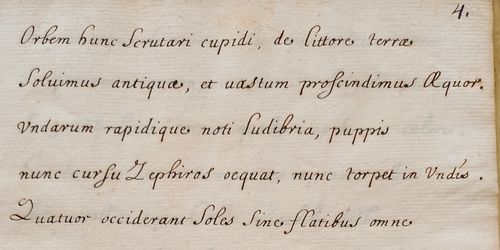
On 9 and 10 March 2026, Martin Korenjak gave two introductory talks on Neo-Latin to the subject coordinators for Latin of Eastern Upper Bavaria in Neufahrn bei Freising and Rosenheim respectively. The talks aimed at familiarizing the listeners with Neo-Latin and at introducing them to the manifold possibilities of using Neo-Latin texts at school.
