



The rector of the Eberhard Karls University of Tübingen, Prof. Dr. Karla Pollmann, visited the University of Innsbruck on 2 November 2026. Her lecture ‘Zwischen akademischer Freiheit und Dienst an der Gesellschaft. Zukunftsszenarien für die Klassische Philologie’ (Between academic freedom and service to society: Future scenarios for Classical Philology) was one of the highlights of the lecture series ‘Zukunft der Philologien’ (The Future of the Philological Disciplines) at the Faculty of Philology and Cultural Studies. As an outstanding classical philologist and Catholic theologian who is also the head of a university of excellence, she was able to explain to the audience the opportunities and prospects for the humanities – and classical philology in particular – from the perspectives of higher education policy and society as a whole.
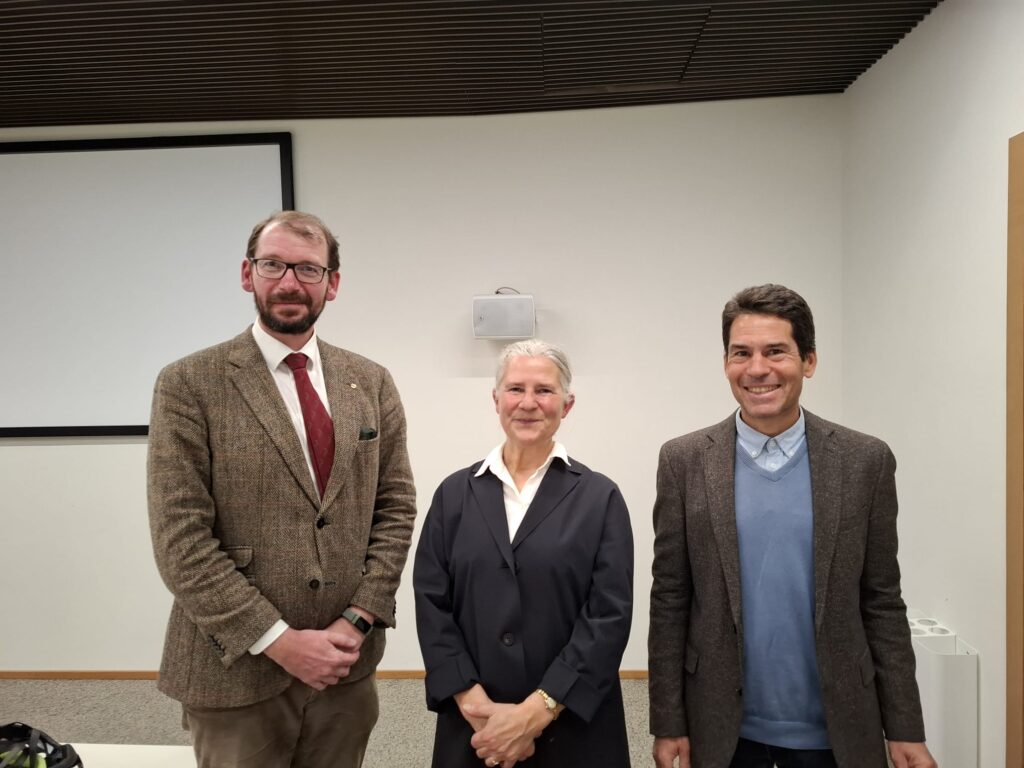
In her lecture, Ms Pollmann began by addressing the major questions facing the humanities as a whole and then, at the end of each individual point, examined in more detail the respective contribution of classical philology. It goes without saying that this contribution was greater in some areas (such as the understanding of European identity) and smaller in others (such as the contribution to the current security debate). In the field of research, she highlighted that philologists are constantly breaking new ground, illustrating this with the quip that, during her own student days, the literary canon extended no further than Tacitus at the very most. She felt it was important to call on Classical Philology, too, to engage with public discourse and to have an impact on society. Precisely because of the long-standing close ties between universities and schools, she argued, this is easier for representatives of our discipline than for those of other disciplines, where the gap between the school and academic worlds is wider.
The audience particularly pleased that, at the end of her presentation, Ms Pollmann went into a little more detail about a best-practice example, choosing the SRA ‘Neo-Latin in the Modern World’ as her case study. By doing so, she sought to demonstrate that, in times of increasingly tight budgets, a strategic focus on a specific goal can not only make more resources available but also ensure that small institutes gain global recognition in specific niches.
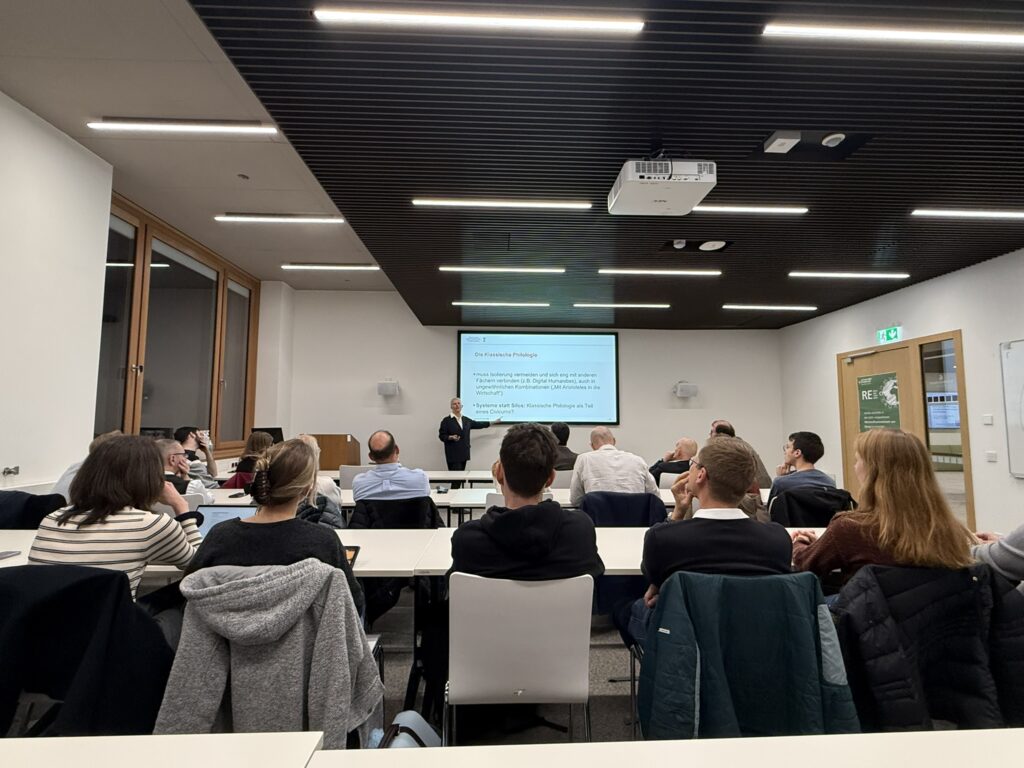
In the discussion that followed, the speaker emphasised that, amongst other things, it is essential to have sufficient humanities scholars represented in politics in order to safeguard the long-term future of the humanities in schools and universities. At the same time, she encouraged the younger attendees in particular never to lose their enthusiasm for classical philology or their belief in their own discipline, simply because some quarters question our right to exist.
Naturally, as a distinguished guest, Ms Pollmann drew a full house to the lecture theatre: from Dean Jürgen Fuchsbauer and numerous professors, through postdocs and PhD candidates, to the students, the entire spectrum of the university was represented amongst the audience. The fact that Her Magnificence took the time after her lecture to chat with the students of Classical Philology over a cosy dinner is a testament to her great personal qualities. Everyone was delighted by her visit!