



From November 11 to 14, 2026, our colleague Riccardo Stigliano—recipient of the University of Ottawa’s Doctoral Mobility Program and Visiting Scholar until December under the supervision of Prof. Geoffrey Greatrex—was invited by Prof. Conor Whately to visit the Department of Classics at the University of Winnipeg.
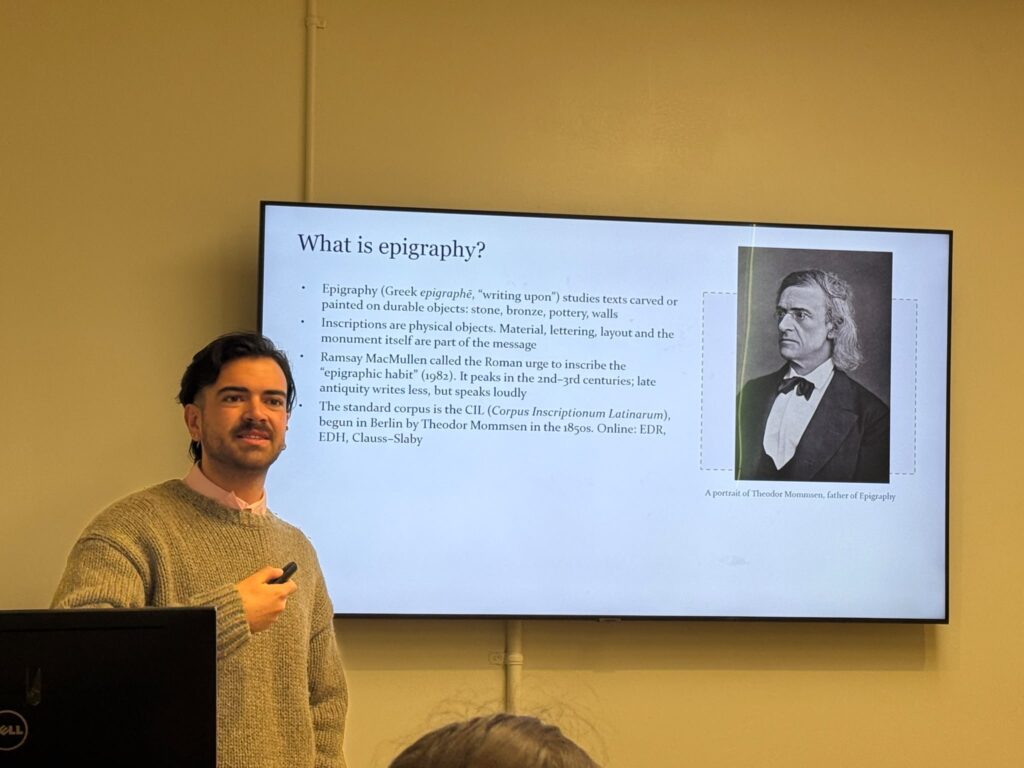
On Thursday, November 12, Riccardo delivered a guest lecture for Prof. Whately’s Latin Grammar class on the Everyday Latin language of Late Antique inscriptions (4th and 5th centuries CE). The session featured an interactive translation workshop in which students were invited to read and translate key primary texts, including the Arch of Constantine, the Rescript of Hispellum (and the scholarly debate surrounding its dating), and several Late Antique inscriptions from the Colosseum (ranging from the original dedicatory inscription to 4th- and 5th-century restoration records).
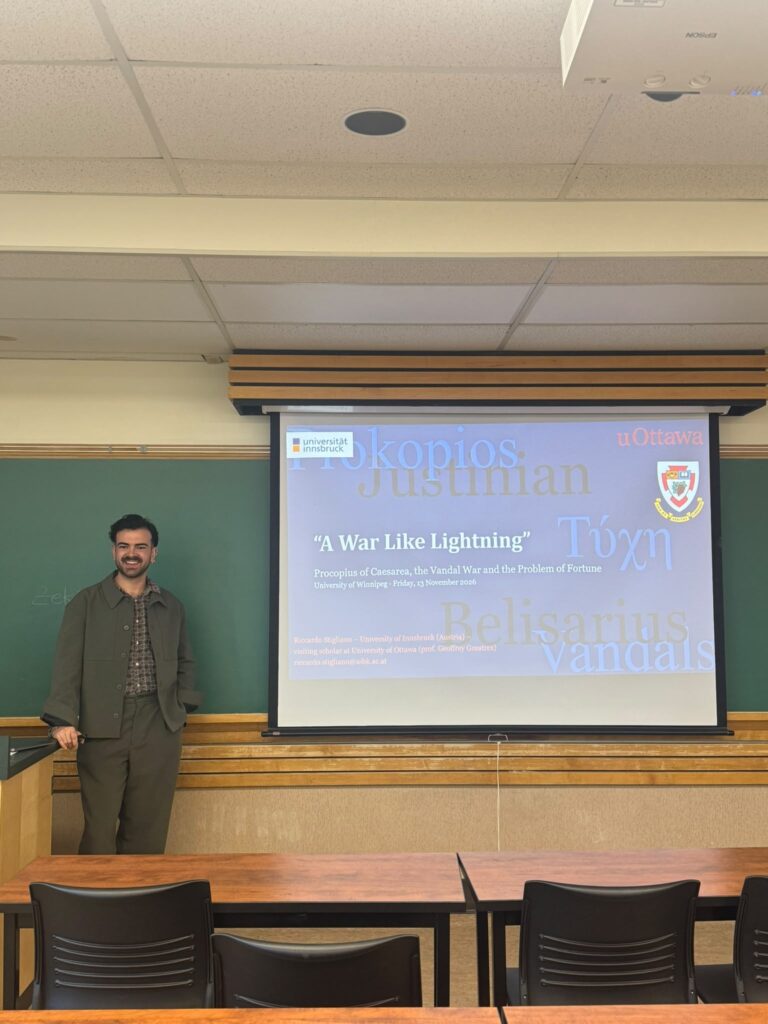
On Friday, November 13, Riccardo gave a public seminar titled “A War like Lightning: Procopius of Caesarea, The Vandal War and the Problem of Fortune.” Drawing on his ongoing doctoral research and his commentary on Book 3 of Procopius’ Wars—a project conceived in direct continuity with Prof. Greatrex’s acclaimed commentary on Books 1–2—he addressed a diverse audience of scholars, students, and members of the local community.

The seminar explored Justinian’s 6th-century reconquest of Vandal North Africa, unpacking its underlying motives alongside both Procopius’ own interpretive frameworks and modern historiographical perspectives. Throughout an engaging discussion, Riccardo argued that the Vandal War—long neglected by humanist, antiquarian, and modern scholarship largely due to its brevity, as the Vandal kingdom collapsed “like lightning” in roughly six months—serves as a crucial litmus test for understanding Procopius’ authorial intentions, narrative sensibilities, and ideological coordinates. Showing how human agency in Procopius’ account ultimately bends to the whims of Fortune (Tyche), which reigns supreme even when investigating historical causation, he demonstrated how this deliberately elusive historian emerges as a classical author remarkably attuned to our contemporary cultural sensibilities.